

There is an understandable instinct that appears whenever a country enters a period of prolonged crisis: businesses begin separating everything they do into two categories, the essential and the non-essential, and because marketing is often incorrectly treated as something that happens after the “real work” has been completed, rather than as part of the commercial system that generates demand, retains customers and protects future revenue, marketing budgets are frequently among the first expenses placed under question.
During wartime this instinct becomes even stronger, because the uncertainty is not theoretical. Ukrainian companies have spent years operating around air alerts, damage to energy infrastructure, employee shortages, migration, disrupted logistics, fluctuating demand, higher operating costs and the very real possibility that plans made on Monday may need to be rewritten by Friday, so it is hardly surprising that an owner looking at the company's expenses may ask a seemingly rational question: why should we spend money telling people about our business when the country is at war?
The problem is that this question starts from the wrong definition of marketing.
Marketing is not the act of pretending that everything is normal, and it is not the act of filling Facebook and Instagram with cheerful advertising while ignoring what people are experiencing around you. Marketing is the system through which a company understands demand, remains visible to customers, communicates value, creates trust, captures intent, retains existing buyers and makes it easier for someone who needs its product or service to choose it rather than an alternative.
Seen this way, the real question is not whether marketing should continue during wartime.
The more useful question is:
How should marketing change when customers, businesses and society are all living under conditions of prolonged uncertainty?
That distinction matters enormously, because the evidence coming from Ukraine in 2025 and 2026 does not describe a market that has stopped functioning; it describes a market that has become more selective, more digital, more price-conscious, more values-conscious and more demanding of relevance, while continuing to buy, search, compare, recommend, advertise and compete.
That means the strategic danger for many companies is not continuing to market.
It is disappearing.
Ukraine's economy has been damaged, but economic life has not stopped
No serious discussion about marketing during the war should begin by minimizing the economic reality.
Ukraine is operating under extraordinarily difficult conditions, and any business strategy that ignores those conditions is not optimism but bad management. According to the International Monetary Fund's July 2026 review, Ukraine nevertheless maintained macroeconomic and financial stability despite Russia's continuing war and intensified attacks on critical infrastructure, while the IMF projected real GDP growth of approximately 1.0–1.6% for 2026 after growth of 1.8% in 2025.
The National Bank of Ukraine likewise confirmed that real GDP grew by 1.8% in 2025 and emphasized something particularly relevant to business owners: private consumption was the largest positive contributor to economic growth, adding around 4.7 percentage points, while business adaptability and domestic demand helped the economy continue recovering despite ongoing attacks and destruction.
Those figures do not mean that business conditions are easy, nor do they mean that every sector is growing.
They mean something much more useful.
People are still participating in an economy.
They are still earning money, receiving salaries, purchasing groceries, replacing appliances, ordering products, going to doctors, hiring professionals, buying software, repairing homes, educating their children, visiting restaurants, maintaining cars, adopting pets, paying for services and making thousands of ordinary commercial decisions every day, even while the circumstances surrounding those decisions are anything but ordinary.
A business cannot control the war, the electricity supply or the macroeconomic environment, but it can control whether a customer who currently needs what that business sells is able to find it, understand it, trust it and buy it.
That is where marketing enters the picture.
The clearest evidence: Ukrainian companies themselves have not stopped marketing
Perhaps the most revealing evidence comes not from theory but from the advertising market itself.
If business had collectively concluded that marketing during wartime was pointless, Ukraine's advertising market should be collapsing.
It is not.
The All-Ukrainian Advertising Coalition reported that the advertising and communications market grew by approximately 12% in 2025, and in its updated August 2026 forecast it still expected the Ukrainian media advertising market to grow another 12% during 2026, despite explicitly acknowledging the continuing risk of energy outages and business losses caused by attacks.
The numbers underneath that headline are even more instructive.
VRK's August 2026 forecast valued Ukraine's total advertising media market at approximately UAH 37.4 billion for 2026, up 12% from 2025. Internet media advertising alone was forecast at roughly UAH 22.2 billion, representing 14% annual growth, while paid search advertising — including part of the Google Display Network — was forecast to reach more than UAH 30.3 billion, approximately 20% above 2025 levels. Influencer marketing was forecast to grow by around 18%, while SMM was projected to increase by roughly 9%.
These are not the numbers of a market that has decided customers no longer matter.
They are the numbers of companies continuing to compete for attention.
This does not mean that every individual business should automatically increase its advertising budget by 12%, 14% or 20%; doing so would be an absurd interpretation of market-level data, because a company with broken supply chains, insufficient capacity or collapsing margins may need to reduce advertising dramatically.
What these numbers demonstrate is something more fundamental:
commercial attention has not disappeared.
If your company becomes silent, the market does not become silent with you.
Your competitor can continue appearing in Google.
Another company can continue publishing useful videos.
Another store can remain visible in Instagram or TikTok.
Another professional can answer the question that your website stopped answering.
Another brand can remain in the customer's memory while yours slowly fades from it.
There is no neutral empty space in a competitive market.
A space that you leave eventually belongs to someone else.
Ukrainian consumers have not stopped buying — they have become much more deliberate
One of the most dangerous assumptions a company can make during wartime is that because consumers are worried about money, they have therefore stopped consuming.
What has actually happened is far more complex.
Gradus Research's 2026 study of Ukrainian consumers found no single dominant spending mentality. Approximately 21% of respondents were classified as savers who carefully control expenses and build reserves, 27% as rational optimizers who control spending without substantially changing their normal lifestyle, 23% as more impulsive consumers oriented toward immediate emotional satisfaction, and 29% as consumers attempting to maintain their usual spending habits despite external conditions.
That distribution matters enormously for marketers because it destroys the simplistic idea of “the wartime consumer.”
There is no single wartime consumer.
There are millions of people experiencing the same national reality while responding to it in different ways.
Some are postponing purchases.
Some are trading down.
Some are buying less but choosing better quality.
Some are protecting familiar pleasures precisely because life feels uncertain.
Some are spending on convenience because they have less emotional energy.
Some are willing to pay more for a trusted local brand.
Some are extremely price sensitive.
Others value service, speed, safety or reputation enough to choose a more expensive option.
Gradus found that price, discounts and special offers remain important purchase triggers, but convenience and care form another major layer of consumer expectations, while approximately a third of consumers pay attention to emotionality and empathy in brand communication and around a quarter expect brands to support people, the country or social initiatives.
This is precisely why abandoning marketing is such an imprecise response to economic pressure.
When purchasing behavior becomes more complicated, companies need better understanding of the customer, not less.
Price matters enormously — but price is not the whole market
There is no value in romanticizing the situation: Ukrainians are highly price-conscious.
Gradus reported in 2025 that 64% of consumers were choosing cheaper brands, while only 25% were moving toward more expensive alternatives, and Deloitte Ukraine's consumer research published in March 2026 likewise described increasingly rational shopping behavior, stronger price sensitivity, more planning and increased interest in discounts, promotions and private-label products.
Yet even those findings should not lead to the conclusion that every marketing strategy must become one giant discount campaign.
A customer who is more careful with money becomes more interested in why something costs what it costs.
That creates a larger role for marketing, not a smaller one.
If your service is 20% more expensive but lasts twice as long, explain it.
If your clinic provides a diagnostic capability that reduces uncertainty, explain it.
If your software saves five employee hours every week, demonstrate it.
If your furniture includes installation and a genuine warranty while the cheaper alternative does not, make the difference visible.
If your delivery is more reliable during outages, say so.
If your product is manufactured locally and purchasing it supports Ukrainian employment, communicate that fact without turning patriotism into empty decoration.
The customer who once bought quickly may now compare five suppliers.
Marketing determines what that customer sees while comparing them.
In other words, economic pressure does not eliminate marketing.
It shifts marketing from persuasion through excitement toward persuasion through clarity, proof and relevance.
Trust has become a commercial asset, not a branding slogan
One of the most important shifts in Ukrainian consumer behavior is the degree to which purchasing decisions are connected not only to functionality and price but also to trust, values and company behavior.
Deloitte Ukraine's study of more than 1,000 Ukrainian smartphone users, conducted at the end of 2025 and published in March 2026, found that 62% of respondents consciously avoid products from companies whose seller or manufacturer has not left the Russian market, while 52% believe companies should direct part of their activity toward supporting Ukraine's Armed Forces and dealing with the consequences of the war. Another 27% said they were prepared to purchase from such companies even if the product cost more.
These findings should not be interpreted as permission to wrap every product in a flag and call it corporate responsibility.
In fact, the opposite conclusion is more useful.
Consumers are paying attention.
If a company says it contributes, people want to know how.
If it claims to support Ukraine, its behavior matters.
If it promotes Ukrainian production, customers may want to know where the product is actually produced.
If it claims social responsibility while behaving badly toward customers or employees, the contradiction becomes part of the brand.
This is why authenticity matters much more than dramatic language.
A company that has actually donated equipment, retained employees, paid taxes, supported volunteers, adapted its workplace or helped a local community can communicate those actions clearly and calmly.
But the order is important:
first do something real; then communicate it.
Do not invent moral purpose because the advertising department needs content.
War is a context in which a brand operates.
It should never become a creative gimmick.
Good marketing during war does not pretend that war does not exist
One of the most useful findings from Gradus Research in 2026 concerned the tone of advertising itself.
Consumers were not asking brands to become endlessly dark or depressing, but neither did they want advertising that presented a fantasy world completely disconnected from the reality surrounding them. According to Gradus, only 9% of consumers responded positively to advertising built around an idealized picture of life, while communications that combined positivity with recognition of real daily challenges were considerably more relevant.
This distinction is crucial.
People need positive emotions.
They need beauty.
They need humour.
They need birthdays, restaurants, gifts, music, fashion, holidays, entertainment and moments that remind them that life is still life.
A Ukrainian consumer does not need every advertisement to remind them of missiles.
But the same consumer can immediately recognize communication that feels absurdly detached from the world around them.
Good wartime marketing therefore occupies a more mature emotional space.
It says:
We understand the environment.
We are still here.
We are still operating.
We have adapted.
Here is how we can help you.
Here is what has changed.
Here is what has not changed.
Here is the value we can provide.
That is completely different from shouting:
EVERYTHING IS AMAZING! BUY NOW!
The strongest communication often becomes quieter during difficult periods, because credibility is more valuable than excitement.

Why disappearing is dangerous even if the business survives financially
Companies often evaluate a marketing cut only through the immediate cash it saves.
If advertising costs UAH 200,000 per month and the company stops advertising, UAH 200,000 appears to have been saved.
The accounting is obvious.
The commercial cost is less obvious because it frequently appears later.
Marketing systems accumulate assets over time: branded search demand, website traffic, search rankings, customer reviews, CRM data, remarketing audiences, email subscribers, social followers, case studies, videos, articles, sales insights and customer familiarity.
When marketing disappears for an extended period, this accumulation stops.
More importantly, competitors continue accumulating.
Imagine two comparable companies entering the same difficult year.
Company A dramatically reduces unnecessary spending but preserves several strategic activities: high-intent search campaigns, customer retention, SEO, useful content, reviews and regular communication with existing customers.
Company B shuts almost everything down for eighteen months.
When conditions improve, Company B does not simply press a button and return to the same position it occupied before the pause.
Its competitor has acquired customers.
Its competitor has gathered reviews.
Its competitor's website now contains another hundred useful pages.
Its competitor understands which messages worked.
Its competitor has built remarketing pools.
Its competitor has improved landing pages.
Its competitor has learned how customer objections changed during the war.
Company B saved cash, but it also created a knowledge deficit and a visibility deficit.
This does not mean Company A necessarily wins.
Markets are more complicated than that.
It means that complete silence has an opportunity cost that financial spreadsheets often fail to show.
Marketing is not advertising, and this distinction can save a company money
When budgets become tighter, perhaps the most important strategic improvement a company can make is to stop using the words “marketing” and “advertising” as synonyms.
Advertising is one component of marketing.
Marketing also includes positioning, customer research, pricing, offer design, retention, CRM, customer experience, referral systems, website optimization, SEO, content, reputation management, sales enablement, conversion optimization and analysis.
A company may therefore reduce advertising and simultaneously improve marketing.
For example, a business spending heavily to acquire new customers while ignoring thousands of previous customers may discover that CRM and retention activity creates more profit than additional prospecting.
A professional service company may find that expensive awareness advertising performs poorly, while detailed articles answering high-intent Google searches generate qualified leads for years.
An e-commerce company might discover that its biggest problem is not insufficient traffic but poor mobile conversion, expensive delivery or weak repeat purchase rates.
A clinic may discover that patients do not lack awareness; they lack enough information to trust the procedure.
A B2B company may discover that sales representatives are receiving leads but losing them because there are no case studies, comparison documents or clear proof of results.
All of those problems belong to marketing.
None is solved simply by buying more impressions.
This is particularly important in wartime because efficiency matters more when uncertainty is high.
The correct response is not necessarily “spend more.”
The correct response is:
waste less, understand more and concentrate resources where they influence revenue.
Digital visibility matters because Ukrainian consumer behaviour is deeply digital
Ukraine's advertising market is increasingly digital because consumer attention is increasingly digital.
Gradus's 2025 media consumption study found that 91% of respondents consumed content via smartphone; 44% reported spending more than three hours a day in messaging platforms, 36% spent more than three hours on video platforms, and 30% spent that amount of time on social networks.
Its March 2026 advertising-perception research found that messengers and social networks were the most common places where Ukrainians noticed advertising, with approximately 48% of respondents encountering advertising there.
Deloitte adds another important layer: 34% of respondents said user reviews helped them make their final purchase decision, TikTok was the most common platform for discovering new products for 19% of respondents, and 27% said they had used AI tools for work or study in 2025, 11 percentage points more than in the previous year.
These statistics describe a consumer journey that is no longer linear.
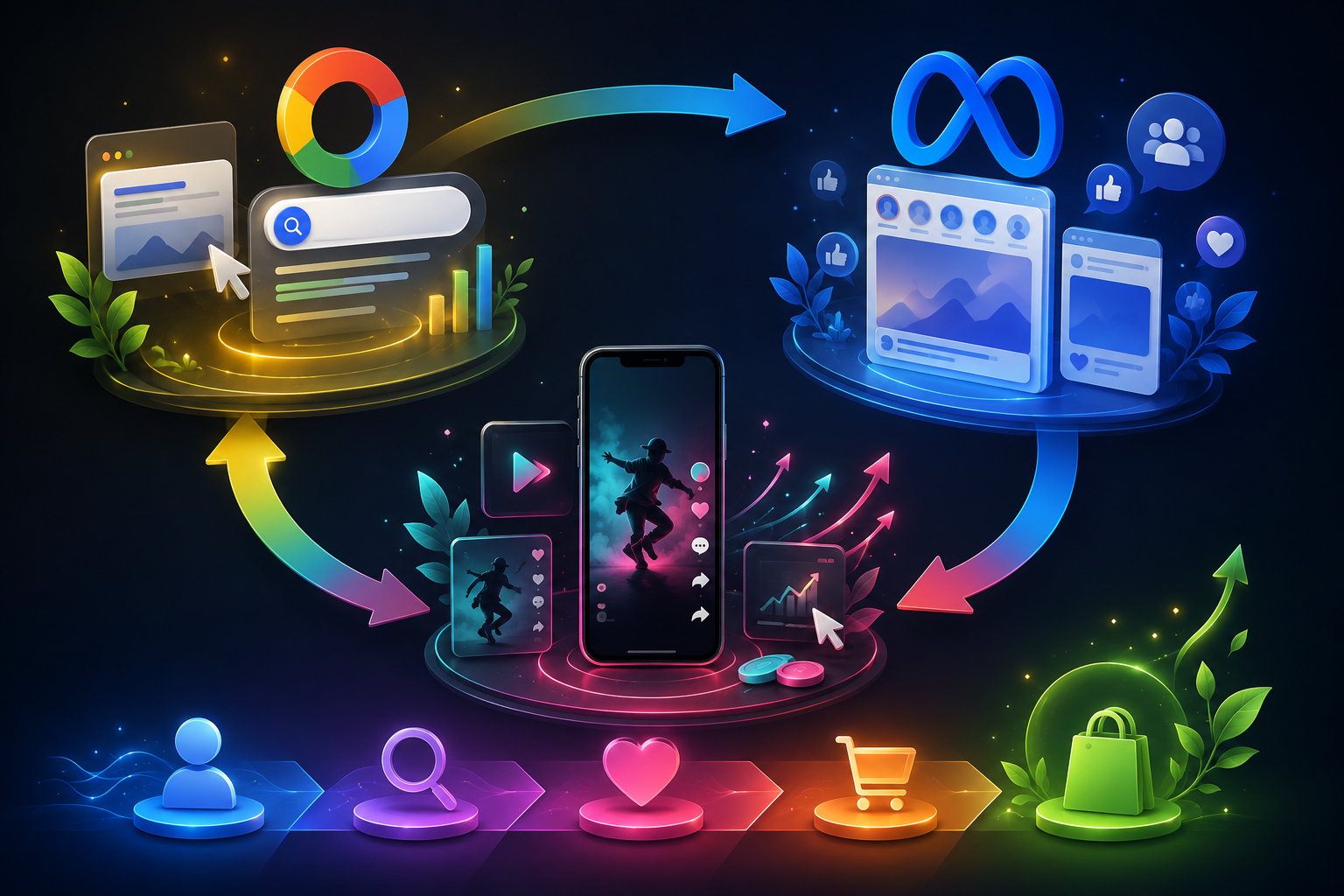
A buyer may encounter a video on TikTok, search the company on Google, read reviews, ask an AI assistant about alternatives, visit Instagram, compare prices, leave, receive remarketing, ask a friend and finally purchase three weeks later.
This means that businesses relying on one channel are increasingly vulnerable.
A company does not necessarily need to be everywhere.
It needs to be present at the moments that matter.
Search marketing may become even more valuable during uncertainty
Search is structurally different from many other forms of advertising because it captures existing intent.
Someone searching:
“emergency electrician Kyiv”
“accounting services for Ukrainian company”
“best generator for apartment”
“dentist open today”
“CRM for small business Ukraine”
“how much does apartment renovation cost”
is not being interrupted with a random message.
That person is actively trying to solve a problem.
The fact that VRK expects Ukraine's paid search market to grow by around 20% in 2026, to more than UAH 30 billion, suggests that businesses continue to place significant value on this kind of intent-driven advertising.
During periods of economic pressure, intent often becomes more valuable than broad reach because companies cannot afford to purchase enormous amounts of attention that never converts.
This is why a rational wartime marketing plan frequently protects high-intent search before protecting broad awareness.
The question is not:
“How many people saw us?”
It is:
“How many people who actually needed what we sell were able to find us?”
More than UAH 30.3 billion in 2026, according to the market forecast cited in the article.
Search captures existing intent: the customer is already trying to solve a problem.SEO is not a luxury when paid acquisition becomes more expensive
The same logic applies to organic search.
Paid traffic ends when payment ends.
Useful content can continue generating visibility long after it is published.
That does not make SEO free, and it certainly does not guarantee quick results, but it changes the nature of the investment.
Suppose an accounting firm publishes a genuinely useful guide answering twenty questions about taxation for Ukrainian entrepreneurs, updates it when legislation changes, builds related service pages, creates expert commentary and earns relevant links.
That content gradually becomes an asset.
The company can rank for searches.
Sales representatives can send the guide to prospects.
Social media can reuse it.
AI search systems may reference it.
Clients may share it.
The same piece of work can participate in multiple stages of the buying process.
A company that stops producing useful information for several years leaves those informational spaces open to competitors.
Again, silence has a cost.
And now there is another layer: GEO and AI discovery
Search behavior is evolving again because consumers increasingly use generative AI tools to research products, services and businesses.
This does not mean that traditional SEO has disappeared.
It means that companies now have an additional visibility problem.
When someone asks an AI assistant:
“What are reliable accounting companies in Kyiv?”
“What should I ask before choosing a cosmetic clinic?”
“How do Ukrainian companies choose a CRM?”
“Which local manufacturers make this product?”
the brands most likely to become part of the answer tend to be those for which the web provides clear, structured and credible information.
This makes simple informational completeness increasingly valuable.
Who are you?
What exactly do you do?
Where do you operate?
Who is your service designed for?
What does it cost?
What problems does it solve?
What evidence supports your claims?
What common questions do customers ask?
What guarantees or limitations apply?
What experience do you have?
What independent sources mention you?
A website containing nothing but slogans such as “quality, innovation and excellence” is not merely weak copywriting.
It is weak data.
The modern brand needs to be understandable to humans, search engines and AI systems.
E-commerce demonstrates that consumption is still very real
Online shopping provides another useful reality check.
Forbes Ukraine reported, based on data provided by Prom, that Ukrainians spent approximately UAH 256 billion on online purchases in 2025, representing growth of about 7% from the previous year.
Promodo's research likewise found continued e-commerce growth across multiple categories, even while businesses faced personnel shortages, constrained purchasing power, expensive digital auctions and energy-security challenges; its analysis emphasized that companies were increasingly prioritizing automation, retention and conversion efficiency rather than simply scaling traffic aggressively.
This is almost a perfect summary of what good wartime marketing should look like.
Not blind expansion.
Not endless acquisition.
Not growth at any cost.
Efficiency, retention, relevance and adaptability.
When customer acquisition becomes expensive, keeping a customer matters more.
When consumers compare prices carefully, the product page matters more.
When electricity disruptions create delivery uncertainty, communication matters more.
When people are tired, convenience matters more.
When traffic costs increase, conversion matters more.
Marketing therefore becomes more operational, not less important.
Estimated online purchases by Ukrainians in 2025, as cited in the article.
Existing customers may be the most valuable audience you have
In periods of uncertainty, one of the most common mistakes is continuing to spend almost exclusively on acquiring strangers while neglecting customers who already know the brand.
Existing customers possess something new prospects do not:
experience.
They already know whether you delivered.
Whether you kept your promise.
Whether customer support answered.
Whether the product worked.
That makes retention marketing extraordinarily valuable.
A practical wartime marketing strategy should therefore pay serious attention to CRM segmentation, repeat-purchase reminders, replenishment cycles, loyalty programmes, referral incentives, useful email communication, WhatsApp or Viber where appropriate, personalized offers and genuine post-purchase service.
This does not mean bombarding existing customers because it is cheaper.
It means treating the customer relationship as an asset rather than viewing every transaction as a completed event.
The strongest acquisition campaign in the world becomes financially fragile when customers never return.
Customer experience becomes marketing when trust is scarce
In normal presentations, customer experience and marketing are often displayed as separate departments.
Customers do not experience companies that way.
If the website says delivery will take two days and the package arrives in seven without explanation, that is marketing.
If a sales representative promises one price and the invoice contains another, that is marketing.
If the Instagram feed is beautiful but customer support ignores complaints, that is marketing.
If the company publicly talks about supporting people while treating employees poorly, that is marketing.
Everything customers experience eventually influences what they tell others.
And reviews matter.
Deloitte's finding that user reviews were the most significant final purchase influence for 34% of respondents should therefore matter to every business owner who still thinks reputation management means “replying to bad Google reviews.”
Reviews are not the end of marketing.
They are the public record of whether the marketing promise was true.
Do not use fear as a conversion tactic
War creates fear naturally.
Brands do not need to manufacture additional fear in order to sell.
There are legitimate situations where urgency is necessary — medical problems, security services, emergency repairs or critical equipment, for example — but deliberately using traumatic images, sirens, explosions or exaggerated catastrophe simply to increase click-through rate can easily create attention at the expense of trust.
A useful test is simple:
Would the message still be commercially relevant if the emotional shock were removed?
If the answer is no, the company may be exploiting the context rather than serving the customer.
A generator seller can explain how much backup power a household needs.
A cybersecurity company can explain actual risk.
An insurance-related service can explain coverage conditions.
A clinic can explain when a symptom requires attention.
All of those messages can be urgent without becoming manipulative.
The standard should be usefulness.
Should marketing budgets be reduced during wartime?
Sometimes absolutely.
There is no responsible marketing philosophy that says budgets should never be reduced.
If revenue collapses, preservation of cash may become the company's immediate priority.
If inventory cannot be replenished, advertising unavailable products is wasteful.
If staff cannot process existing demand, purchasing additional leads may make the customer experience worse.
If a campaign has been unprofitable for six months, “staying visible” is not a justification for continuing to burn money.
The argument for continuing marketing should never become an argument against financial discipline.
Instead, budget decisions should become more granular.
A company should ask:
Which channels create measurable revenue?
Which campaigns capture genuine intent?
Which activities support existing customers?
Which channels primarily produce vanity metrics?
Which campaigns would damage future demand if removed completely?
Which spending can be paused?
Which investment becomes more valuable precisely because competitors are becoming quieter?
The result may be a marketing budget that is 50% smaller.
But it should be a designed reduction, not a panic shutdown.
A simple wartime marketing framework: Protect, Prove, Perform, Prepare
Rather than trying to reproduce the marketing plan of a peaceful year, Ukrainian companies can organise activity around four practical priorities.
Protect
Protect the assets the company already has: customer relationships, branded search demand, reputation, website visibility, CRM data, reviews, key social channels and essential high-intent advertising.
Prove
Replace vague promises with evidence: case studies, demonstrations, transparent pricing, customer testimonials, real delivery information, comparison pages, certifications, expertise and concrete explanations.
Perform
Measure commercial outcomes rather than activity. Track qualified leads, customer acquisition cost, conversion rate, sales rate, average order value, margin, repeat purchase rate, lifetime value and contribution to revenue.
Prepare
Continue building assets that will matter when conditions improve: SEO, content libraries, customer databases, automation, brand recognition, video, partnerships and first-party data.
This approach avoids both extremes.
You do not behave as though nothing has changed.
And you do not behave as though no future exists.
Preserve demand, relationships, reputation, data and high-intent visibility.
Replace vague promises with evidence, transparency, expertise and real-world proof.
Measure customers, margin, qualified leads, revenue and repeat purchasing.
Keep building assets that matter when conditions improve.
What should a 90-day marketing plan look like?
A useful ninety-day plan begins with diagnosis rather than content.
During the first month, understand the numbers.
Identify where leads originate, which products generate margin, which campaigns create customers rather than merely inquiries, where people abandon the website, which questions sales teams repeatedly receive, what customers complain about and which previous customers are most likely to purchase again.
During the second month, improve the system.
Fix landing pages, create missing information, improve tracking, request reviews, clean the CRM, strengthen follow-up processes, rebuild weak offers, produce comparison content and concentrate media budgets on channels that demonstrate intent.
During the third month, experiment carefully.
Test new creative.
Test a new audience.
Test video.
Test remarketing.
Test a referral offer.
Test email sequences.
Test AI-search-oriented informational content.
The key word is test.
In an unstable environment, certainty is expensive.
Learning quickly is more valuable.
Understand sources, margins, lead quality, website drop-off, objections and repeat-purchase potential.
Fix landing pages, tracking, CRM hygiene, follow-up, offers, reviews and high-intent media allocation.
Test creative, video, remarketing, referral offers, email sequences and AI-search-oriented content.
Marketing must become closer to sales
One of the worst organizational habits is allowing marketing to report impressions while sales reports revenue and nobody asks whether the two systems are connected.
During wartime, that separation becomes harder to justify.
Marketing should know:
How many leads were contacted?
How many were qualified?
Why did people refuse?
Which campaign produced customers with the highest margin?
Which service attracts people who never buy?
What objections appear more frequently today than six months ago?
Sales should know:
Which advertisement the lead saw.
Which page they visited.
Which content they downloaded.
Which promise created their expectation.
The closer these teams become, the easier it is to reduce waste.
The right KPI is not always the cheapest lead
This deserves special emphasis.
A campaign that generates a lead for UAH 200 is not necessarily better than one generating a lead for UAH 500.
Suppose Campaign A generates 100 leads at UAH 200.
Total cost: UAH 20,000.
Five become customers.
Campaign B generates 40 leads at UAH 500.
Total cost: also UAH 20,000.
Ten become customers.
Campaign B has the “worse” lead price and twice as many customers.
This elementary example illustrates a surprisingly common reporting problem.
Marketing becomes dangerous when optimisation stops too early in the funnel.
Companies should move as far toward revenue and profit as their data permits.
Not:
How cheap was the click?
But:
What happened after the click?
The deeper reason to continue marketing: a business needs a future tense
There is also a reason that goes beyond advertising metrics.
A company that permanently manages only today's emergencies eventually loses tomorrow.
Marketing is one of the few functions in a business explicitly responsible for the future: future customers, future demand, future positioning, future products and future revenue.
Operations asks:
How do we deliver today?
Finance asks:
How do we pay today?
Marketing must also ask:
Why will someone choose us six months from now?
During war, this question becomes harder.
That does not make it less important.
It makes it more important.
Deloitte and the American Chamber of Commerce reported in 2026 that 58% of surveyed companies were systematically implementing business-continuity plans, illustrating how Ukrainian companies are increasingly treating resilience as a structured management discipline rather than a temporary emergency response.
Marketing deserves the same treatment.
It should be part of continuity planning.
Not an optional decoration added when the crisis ends.
Frequently Asked Questions: Marketing During Wartime in Ukraine
Is it morally appropriate to advertise during a war?
Yes, provided the communication is responsible and the company is genuinely delivering something people need or value.
Economic activity does not stop being legitimate because a country is at war. Businesses employ people, pay suppliers, generate tax revenue and provide goods and services that society continues to use.
The ethical question is not whether the company communicates.
The ethical question is how.
Do not exploit grief, fear or tragedy.
Do not invent patriotic credentials.
Do not present a fake reality.
Be useful, respectful and honest.
Should every company continue spending the same amount on marketing?
No.
Marketing expenditure should respond to cash flow, demand, capacity, inventory, margins and risk.
Some companies should increase spending.
Some should maintain it.
Some should reduce it dramatically.
The important distinction is between a strategic reduction and total disappearance without analysis.
What should I cut first when cash is tight?
Usually, activities that consume budget without providing either measurable commercial return or clear long-term strategic value deserve scrutiny first.
This may include poorly targeted awareness campaigns, duplicated software, weak channels, excessive content production, low-quality lead sources or campaigns that cannot be connected to revenue.
High-intent acquisition, retention systems and proven profitable activity often deserve stronger protection.
Should my brand mention the war?
When relevant.
A logistics company may need to explain delays.
A business dependent on electricity may need to communicate backup capabilities.
A local company may wish to explain support initiatives.
But there is no reason every post must mention the war.
Customers also need ordinary life.
Is positive advertising inappropriate?
No.
Gradus research suggests Ukrainians do want positivity, but they respond poorly to positivity that appears completely detached from reality.
The distinction is between hope and denial.
Brands can make people smile.
They simply should not appear oblivious.
Are Ukrainians still spending enough to justify advertising?
The answer depends heavily on category, region and audience, but nationally the evidence clearly shows continuing consumption, a functioning e-commerce market and ongoing growth in advertising expenditure.
Ukraine's e-commerce market was estimated at approximately UAH 256 billion in 2025, while private consumption was the largest positive contributor to GDP growth that year.
Consumers have not disappeared.
They have become more selective.
Should we compete mainly on price?
Only when price is genuinely your competitive advantage.
Price sensitivity is strong, but Deloitte, Gradus and other Ukrainian market research consistently indicate that quality, familiarity, reviews, convenience, trust, values and social responsibility continue influencing purchasing decisions.
A company that competes only on discounts may eventually train customers to value nothing except the next discount.
Which marketing channels matter most?
There is no universal mix.
For a local emergency service, Google Search may dominate.
For a fashion retailer, Instagram, TikTok, creators, performance media and CRM may matter more.
For B2B, expert content, search, LinkedIn, email and direct outreach may outperform mass consumer channels.
For e-commerce, paid search, shopping campaigns, social media, retention and conversion optimisation usually need to work together.
Choose channels around customer behaviour, not fashion.
Is social media enough?
Usually not.
Social media is rented attention.
Algorithms change.
Accounts can lose reach.
Platforms change rules.
A stronger system combines social media with assets you control more directly, including a website, CRM, customer database, email list, content archive and first-party analytics.
Should we invest in SEO when we need results now?
SEO should not replace short-term acquisition when immediate revenue is necessary.
It should complement it.
Paid search can capture today's demand.
SEO and useful content help build tomorrow's lower-cost visibility.
The strongest strategy often uses both.
Does GEO or AI optimisation really matter yet?
It increasingly matters because customers are beginning to use AI systems for research and comparison, while Deloitte found a substantial increase in AI use among Ukrainian consumers during 2025.
There is no magic “AI SEO” switch.
Start by making your business exceptionally understandable online: clear service pages, expert answers, structured information, credible references, reviews and accurate company data.
Should a company communicate its support for Ukraine?
If that support is real, yes.
Specific communication is generally stronger than slogans.
Explain what was provided, to whom, when and through what mechanism when disclosure is appropriate and safe.
Actions create credibility.
Slogans merely describe it.
What if customers accuse us of profiting during the war?
Any commercial activity can attract criticism, but running a functioning business is not inherently exploitation.
The important considerations are behaviour, pricing, transparency and tone.
A company supplying a useful service at a fair price while employing people and paying its obligations is participating in the economy.
A company manipulating fear, price gouging during emergencies or fabricating social impact is a different matter.
What is the single biggest mistake businesses make with marketing during wartime?
Treating the decision as binary.
Marketing ON.
Marketing OFF.
Reality requires more intelligence than that.
Reduce what is wasteful.
Protect what works.
Strengthen trust.
Stay findable.
Maintain customer relationships.
Continue learning.
Build assets for the future.
The final point: do not wait for the “normal market” to return
It is tempting to imagine that one day circumstances will become normal again and companies will simply restart the strategies they paused.
But markets do not wait.
Customer behaviour continues evolving.
Search algorithms change.
AI changes discovery.
Competitors collect reviews.
New companies enter.
People develop new habits.
Brands are remembered.
Others are forgotten.
The Ukrainian economy itself illustrates this extraordinary process of adaptation: despite war, destruction and profound uncertainty, businesses continue operating, consumers continue buying, digital commerce continues functioning and the advertising market continues growing.
The purpose of saying this is not to romanticize resilience.
It is to recognize reality.
A business cannot decide when the external crisis will end.
It can decide whether it continues building commercial relevance while the crisis exists.
That may mean spending less.
It may mean abandoning old campaigns.
It may mean moving almost entirely to performance.
It may mean investing in retention instead of acquisition.
It may mean building content while competitors are quiet.
It may mean changing the product.
It may mean changing the message.
But unless the business itself is closing, completely abandoning the relationship with the market is rarely a neutral decision.
Because while you are waiting for customers to return, those customers are already somewhere.
They are searching.
Comparing.
Reading.
Watching.
Asking AI.
Checking reviews.
Listening to friends.
Walking into stores.
Opening websites.
Making decisions.
And choosing companies.
The strongest wartime marketing strategy is therefore not about being louder.
It is about remaining useful enough to be considered, credible enough to be trusted and visible enough to be found.
Marketing during war is not about pretending that life is normal.
It is about helping a business continue functioning in a world that is not.
And sometimes the most important marketing decision a company can make is simply this:
do not disappear.