
Some businesses run Google Ads. Others publish on Instagram, promote posts on Facebook, or try to create content for TikTok. Every channel works, every provider presents its own numbers, and every month ends with a different report.
But one thing is often missing: the connection between all these activities into one marketing system. Today’s customer rarely sees one ad and immediately buys. They may discover a video on TikTok, see a post on Instagram, search the brand on Google, read an article, return through a Meta ad, and only then submit their details.
ONE SYSTEM, MULTIPLE TOUCHPOINTS
What Does “Closing the Marketing Loop” Mean?
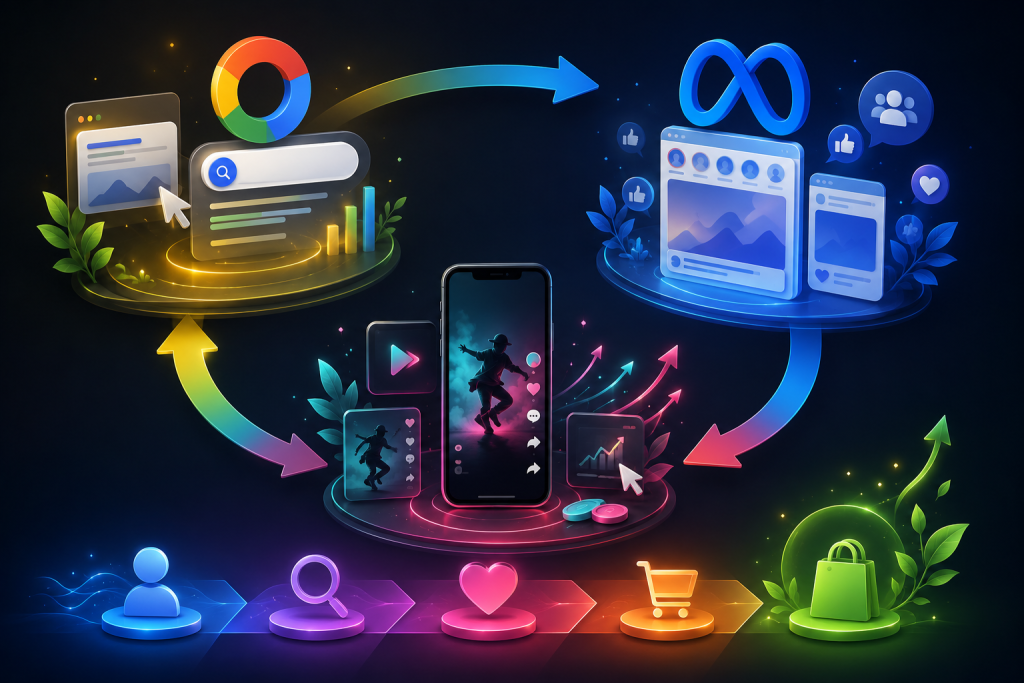
Closing the marketing loop means creating a planned sequence between every point of contact a potential customer has with a business. Instead of treating each platform as a separate unit, the brand builds a connected journey.
The customer first encounters the brand.
A message or creative angle becomes relevant.
The customer searches, compares, and reads.
Content, repetition, and proof reduce uncertainty.
The customer submits details, contacts, or buys.
A person may first see a short TikTok video, later encounter the brand on Instagram, then search for the topic on Google, read an organic article, return through a remarketing campaign, and only then convert. The final click may belong to one platform, but the conversion was created by the entire loop.
DIFFERENT CHANNELS, DIFFERENT JOBS
Every Platform Should Play a Specific Role
Captures active demand when the customer is already searching for a solution.
Meta
Builds familiarity, strengthens trust, and brings interested audiences back.
TikTok
Creates discovery, attention, cultural relevance, and early-stage awareness.
The mistake is not using all three platforms. The mistake is expecting all three to perform the same task.
CAPTURING ACTIVE DEMAND
Google Paid and Organic: Search, Intent, and Authority
Google Ads
Google Ads is especially powerful when demand already exists. A person searching for a marketing agency, legal service, beauty treatment, or smart-home system has already expressed a need.
- Match keywords to real search intent.
- Align the ad with the user’s question.
- Send traffic to a focused landing page.
- Track calls, forms, purchases, and qualified leads.
- Use campaign data to sharpen messaging across other channels.
Organic Search
Organic search builds long-term assets: useful articles, service pages, guides, comparisons, FAQs, and case studies. These assets help customers research, understand, and trust the business.
- Build content around real customer questions.
- Create strong service and category pages.
- Use paid-search insights to guide SEO priorities.
- Turn high-performing organic pages into remarketing entry points.
- Strengthen branded search results and authority.
FAMILIARITY, TRUST, AND REMARKETING
Meta Paid and Organic: Turning Attention into Repeated Exposure
Organic Meta Content
Facebook and Instagram show customers who stands behind the brand, how the business thinks, what it knows, and how it communicates. Organic content helps the profile become a trust-building environment rather than an empty storefront.
Introduce the problem, idea, or point of view.
Show expertise, examples, and deeper explanations.
Present a focused offer, proof, or clear next step.
DISCOVERY, CULTURE, AND CREATIVE TESTING
TikTok Paid and Organic: From Native Content to Scalable Reach
TikTok Organic Is the Creative Laboratory
TikTok users are not necessarily searching for a business. They are watching, learning, discovering, and being entertained. That is why content must feel native to the platform rather than like a traditional commercial.
“We are an experienced marketing company.”
“This is the mistake we see in almost every advertising account we audit.”
Organic performance can reveal which hooks, topics, faces, formats, and emotional angles naturally hold attention. Paid TikTok activity can then amplify the strongest content instead of guessing from the beginning.
THE SYSTEM IN ACTION
What a Complete Marketing Loop Looks Like
A short video presents a common problem or mistake.
The strongest creative is promoted to wider audiences.
Interested users read a detailed article or service page.
Visitors see a case study, testimonial, or deeper explanation.
The customer searches for the brand or relevant service and converts.
The last click may belong to Google, but the trust may have been built through TikTok, Instagram, Facebook, and organic content.
MEASURE THE JOURNEY, NOT ONLY THE LAST CLICK
The Measurement Model Must Be Shared
When each platform is measured separately, the business receives only a partial picture. TikTok may appear to generate views, Meta may appear to generate engagement, and Google may receive most of the conversion credit. But the earlier touchpoints may have created the demand that Google eventually captured.
Branded Search
Are more people searching for the business by name?
Return Visits
Are users coming back after the first interaction?
Lead Quality
Which channels contribute to better opportunities?
Time to Convert
How long does the journey take from first touch to action?
Message Performance
Which topics and angles move people forward?
The goal is not to prove which platform won. The goal is to understand how the platforms worked together.
THE BIGGEST STRATEGIC MISTAKE
Managing Channels Instead of Managing the Customer Journey
Every platform receives a different message with no shared strategy.
Organic content is disconnected from paid campaign insights.
Remarketing audiences are not segmented by behavior or depth.
The final click receives all the credit for a multi-touch journey.
A strong strategy begins when the business stops asking which platform “won” and starts asking how every platform contributed to the final result.
The Strongest Marketing Strategy Is Not a Channel. It Is a System.
Google captures demandwhen the customer is ready to search.
Meta builds familiarityand keeps the brand present.
TikTok creates discoveryand tests creative at speed.
Organic content builds authoritywhile paid media creates reach and control.
The real power appears when everything connects: content creates audiences, paid campaigns distribute winning messages, search captures demand, remarketing strengthens trust, and measurement reveals the full journey.