

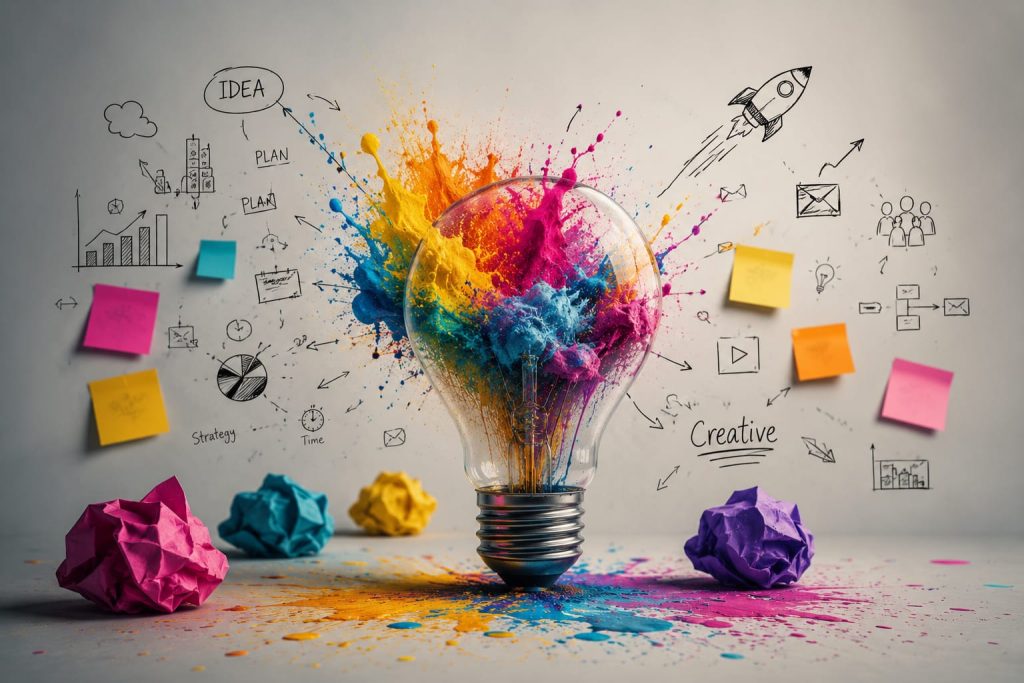
Creative is not just attractive design, a polished video, or a clever-sounding sentence. Creative is how a brand stops someone mid-scroll, sparks interest, builds trust, and inspires action.
In other words, creative is the connection between the message and the audience. That is why more businesses, companies, and marketers are adopting a creative lab approach: a structured process that goes beyond gut feeling by developing ideas, creating variations, testing performance, and improving content over time.
From guesswork to method
What Is a Creative Lab?
The term “creative lab” does not necessarily refer to a physical room, advanced production equipment, or a large team. Above all, it describes a way of thinking.
In a real laboratory, no one assumes the first experiment will succeed. A hypothesis is formed, tested, measured, compared, and refined. Marketing content should be approached in exactly the same way.
One post goes live, everyone hopes for the best, and then moves on.
Develop several directions, test them, and use the data to improve.
Instead of settling for one headline, test three. Instead of publishing one video and waiting for a result, film several opening hooks and examine which one stops more people. This is how creative stops being a matter of luck and becomes a professional process that can be studied and repeated.
One service, three angles
How Does a Change in Messaging Transform the Creative?
“A professional facial treatment tailored to you.”
Clear and informative, but not always powerful enough to stop the scroll.
“Even if you invest in your skin, you may be overlooking the most important thing.”
Touches on a concern and encourages the audience to reassess.
“What has your skin been trying to tell you?”
Creates an information gap and a desire to discover what comes next.
All three messages promote the same service, but each activates a different emotion. Only testing can reveal which angle works best for a particular audience.
A good idea is only the beginning
Why Doesn’t a Good Idea Always Succeed?
One of the most common assumptions in marketing is that a good idea is guaranteed to work. In reality, even an excellent idea can fail.
- The opening hook is not strong enough.
- The visual does not attract attention.
- The message is too complex or too generic.
- The call to action is unclear.
- The content reached the wrong person or appeared at the wrong time.
The lab in action
This Is What Creative Looks Like in Motion
Sometimes the best way to understand an idea is to see it in action. The following video captures the pace, thinking, and energy behind the creative process.
Don’t Fall in Love with the First Idea
Creators, designers, and business owners often fall in love with the first version. They invest hours in it, choose a visual, refine the wording, and become convinced they have reached the perfect result. But the audience does not see the hours of work. They encounter the content for a second or two and decide whether to stop or keep scrolling.
“We offer marketing services for businesses.”
“Investing in marketing but still unsure where your leads are coming from?”
A process you can start tomorrow morning
How to Build a Creative Lab in Your Business
Collect Ideas Consistently
Every customer question, sales objection, interesting comment, or professional insight can become a content idea.
Create Multiple Variations
For the same idea, create a pain-focused hook, a benefit-focused hook, a curious question, or a common mistake. This reveals which angle works.
Test One Variable at a Time
Use the same video with two opening hooks, or the same headline with two visuals. A focused change helps identify what truly made the difference.
Document the Results
Record the idea, opening hook, format, data, and business outcome. Over time, this creates a knowledge base that sharpens the work from one campaign to the next.
You do not need a ten-person team. Start with an organized spreadsheet, several variations for each idea, and a consistent habit of documenting and learning.
Without data, there is no learning
Which Metrics Really Matter?
Good creative is not measured by likes alone. Sometimes a video receives many views but generates no inquiries, while a video with less reach may attract higher-quality customers. That is why performance must be examined across several layers.
Stopping Power
Did people stop for the content or keep scrolling?
Viewing
How long did they stay, and when did they leave?
Engagement
Did they comment, save, share, or return to the content?
Clicks
Did they move to the next page or request more information?
Conversion
Did they submit details, make a purchase, or get in touch?
The right metric depends on the objective. Brand content should not be measured in the same way as an ad designed to generate leads.
What Can Hold the Lab Back?
The Most Common Mistakes
Creating content only because it is publishing day.
Copying a trend without checking whether it fits the brand.
Using the same design and structure again and again.
Changing direction too quickly, before enough data has been collected.
A creative lab requires a balance between patience and flexibility: do not give up too quickly, but do not cling to a version that is not working.
More possibilities, not less thinking
How Does Artificial Intelligence Fit into the Process?
Artificial intelligence can accelerate processes, expand the number of creative directions, and help generate variations—but it does not replace human understanding.
The strongest results come from combining creativity, experience, data, and AI tools. Technology increases the pace of experimentation, but strategy determines which experiments are worth testing.
Content that answer engines can understand
GEO Optimization: Content That Is Not Only Read, but Retrieved as an Answer
Today, strong content must be optimized not only for traditional Google search, but also for AI-powered answer engines. To appear in these answers, an article needs to be clear, well structured, and rich in useful explanations.
An article about a creative lab should explain not only what the concept means, but also how to build the process, what to test, which mistakes recur, and which metrics matter. The more structured and in-depth the content is, the easier it becomes for search engines and AI systems to understand it and present it as a useful source.
A Creative Lab Is Not a Place. It Is a Working Method.
Instead of guessingTest.
Instead of falling in love with one ideaCreate options.
Instead of relying on gut feelingAnalyze data.
Instead of producing more and more contentBuild a system for learning and improvement.
Businesses that adopt this approach do more than create better creative. They gain a deeper understanding of their audience, extract more value from every campaign, and build a valuable marketing knowledge base over time.